Lilleborg
The Hanging GirlLilleborg is a fortress on a hill in a forest meadow, its granite walls rising above a landscape that appears flat and wet. During the pursuit of June Habersaat, the site’s difficult, unfamiliar terrain delays Carl Mørck and Assad and shapes the encounter that brings them to her. The abandoned car on the road points toward the hill; the fortress’s walls and concealed approaches make the last part of the search uncertain.
Setting and Approach
The approach to Lilleborg begins with a car found about four hundred meters down the road from the sound of screeching brakes and a muffled impact. It lies on its side in a small parking space, where two stripes of burned rubber and churned grass suggest that June had braked hard and left the roadway. The marks make the car more than an abandoned vehicle: they indicate a hurried stop, while June herself has disappeared. The road continues in the direction of Rønne, but Carl and Assad remain at the scene, trying to determine where she went.
The fortress first appears through an abrupt change in the landscape. A hill rises in the middle of the forest, in an otherwise flat, wet meadow, an unusual prominence close to the road. Information posters identify a castle formation on its summit; five meters farther on, a sign between two red posts points toward Lilleborg. From the road, Carl can tell that reaching the site requires going up and around the hill. The signage supplies a name and a direction, but not the layout of the ground ahead.
The Fortress and the Search
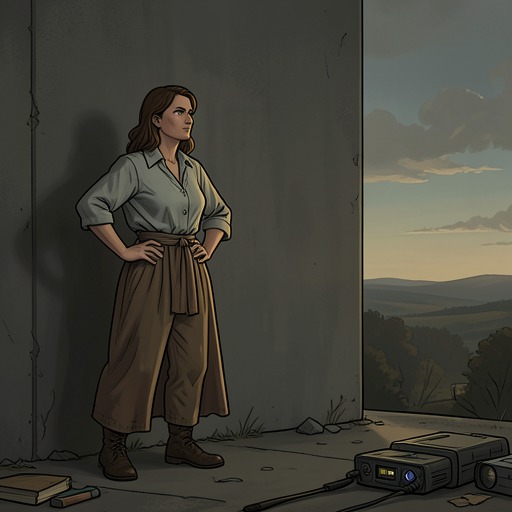
At the hill, Carl and Assad encounter a granite boulder wall that the grass and shrubs have not covered. They know nothing about Lilleborg’s layout. Their lack of familiarity matters immediately: with the pursuit pressing forward, they must read the terrain as they go rather than follow a clear plan through the fortress.
The approaches divide around a steep slope descending toward a lake behind the meadow. A path runs down along the edge to the left, but the sound that has drawn their attention did not come from that direction. To the right, the route crosses huge boulders and cliffs, bordered by a metal railing intended to keep people from falling into the gorge. The site is therefore not simply a hilltop destination. Its drop-offs, rock, and branching paths complicate the search, while the wall conceals the ground immediately beyond it. Assad is struggling with the slope, so Carl takes the lead.
As they move among the stones, a large branch snaps. Assad recognizes that June may be waiting for them, and the uncertainty of the search gives way to the expectation of an ambush. The sounds and obstacles have made the terrain part of the confrontation: the pursuers cannot see June, yet the wall and the routes around it constrain where they can look and how they can approach.
June Habersaat’s Capture
Carl and Assad eventually find June lying in grass about a meter below the stone wall. When she sees them, she swings a thick branch and strikes Assad on his disfigured hand. His scream blends with hers; the pain and suddenness of the blow cause June to drop the branch and retreat to a corner of the wall. Carl lunges, hauls her up, and pulls her arms behind her back to cuff her.
The capture also reveals that June is injured. When she cries out as Carl restrains her, he realizes that her left shoulder is hanging and several fingers on her left hand are dislocated. Lilleborg is thus the place where a pursuit marked by the wrecked car becomes a close physical struggle, and where June’s vulnerability becomes visible at the moment she is apprehended.
Narrative Significance
Lilleborg’s role in the episode comes from the contrast between its outwardly legible signs and its difficult interior. A poster and a directional arrow identify the fortress, but neither tells Carl and Assad how its wall, slope, paths, boulders, and cliffs fit together. The search becomes a test of movement through an unfamiliar place, with the lake and gorge defining the risks on either side of the approach.
The landscape also shapes the encounter’s reversal. The car’s tire marks and churned grass suggest a trail, but June is not waiting beside the road; she is concealed below a wall, where the pursuers must close the distance before they can see her. The fortress’s uneven ground permits that concealment and turns discovery into an attack at arm’s length. Lilleborg consequently serves not only as a named location but as the physical setting that delays, narrows, and finally concentrates the pursuit into June’s capture.